


I’m deep in my notebook this week, organizing all the ideas I’ve had for my new middle grade fantasy into a story. This part of the process is gratifying and exhausting. It’s a thrill when an idea slots neatly into my outline, but reading my notes and making sense of them is taxing. Sometimes I know exactly where an idea will go. Other times it feels like I’m randomly planting something in my yard with only a vague notion of what it will look like once the garden is filled in. No matter how carefully I think it through, there are always plants that need to be moved later. Just like there are always parts of my story that will need to be rearranged.
This installment of Mel’s Notebook is emailed to paid subscribers every Thursday. Become a paid subscriber for behind-the-scenes career news, free critiques of your work, and direct Q&A with me as well as a paid subscriber chat and access to my full archives. Subscribe today for exclusive access to support your writing. ❤️
Using a planting matrix to create
One of the tools I use to make sense of gardening is called a planting matrix. The one below is from Prairie Up, which offers a lot of great advice on how to plant a native garden. When you plant in a matrix, you create a structure by repeating one plant throughout the area. Often this plant is a ground cover or a native grass. This unifies the garden and suppresses weeds. It also helps stabilize moisture levels and provides a framework to plant other species.
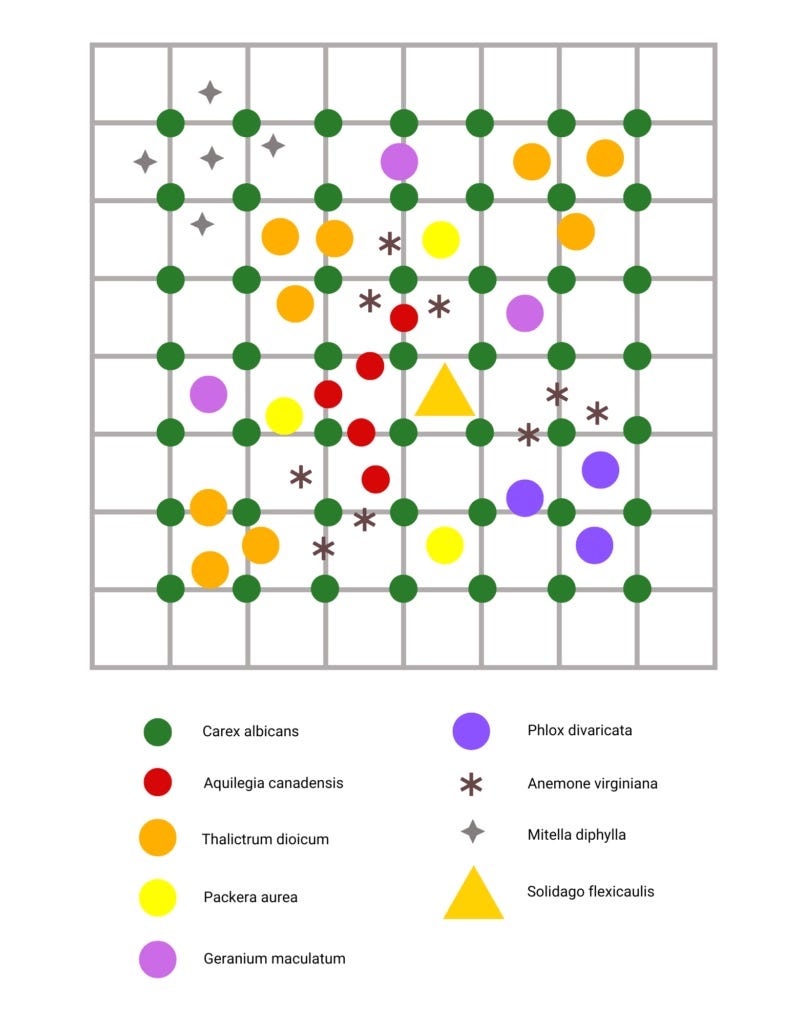
What’s cool about a planting matrix is how that underlying structure brings order to the area. That makes it easier to place the other plants in little repeating clusters. Sometimes those secondary plants have to be rearranged because the height or light level isn’t right for that part of the garden, but that’s something that’s hard to predict without growing for a season.
Books are pretty much the same process for me.
I create the framework for my story from my character’s growth arc, using that repeated touchstone to suppress tangents that do not fit my story and providing a concrete framework that the plot must fit into to feel cohesive.
Character as the foundation of story
My character provides the underlying structure for my stories. They start the story one way and end it having grown and changed. This is one of the first things I figure out about a story: who my character is and how they change.
These are the prompts I use to create a character’s arc:
