


Today’s paid newsletter is free for all to read.
This week, in case you missed it, the Ambassador for Young People’s Literature published a book on writing for children. In this book, he says that “94.7 percent of kids’ books are crud,” which is a reference to a scifi writer from the 1950s who said that 90% of the work in his field was crud. Mac Barnett didn’t just use the 90% line. Instead, he upped it to 94.7%, which was probably a poor attempt at humor. He has since apologized briefly at an in-person book tour event without addressing specifics. Well, I’m going to address the specifics because I’m bone tired from seeing my colleagues in children’s literature get shit on left and right by book banners, self-righteous adult gate keepers, and privileged creators who rarely lift anyone else up.
This installment of Mel’s Notebook is emailed to paid subscribers every Thursday at 9AM EST. If you would also like to receive it by email, become a paid subscriber and and get a peek behind the scenes of my creative life!
This is not a piece for the academics. This is for my fellow creators—those of us who have toiled for decades in this space and those who aspire to publish children’s literature. I’ve been writing for young readers since 2012. I have had the good fortune to learn from the best in the business, and here is what I know to be true.
Writing for young readers is HARD.
Not only are we artists, we are making art for CHILDREN.
Because of this choice, most of us have been belittled for making art that is not primarily for adults. I say “not primarily” because many adults absolutely do enjoy children’s literature whether they want to admit it or not. And you know what? That’s because we make art that is universally accessible and that is hard as hell to do.
Why do we do this work if it’s so damn hard?
We create for children because we love them. That’s it. That’s the crux of why people make children’s literature. Out of love. We care deeply for young people and we want to give them stories that delight and inspire them. We want to give them the information they need to navigate life with joy and safety. We want to support them in every way they need and make them laugh through happy tears.
Most of us were weirdos as children. We made art in the face of constant judgment for not being more practical, more grounded, or more realistic about what we wanted to do with our lives. Mac Barnett’s denigration of us is nothing new and yet it stings SO MUCH because the call is coming from inside the house, from someone who is not only supposed to be an ally, but a representative to advocate for us in the face of those who would tear us down.
Instead, he joined in, punching down at his fellow creators.
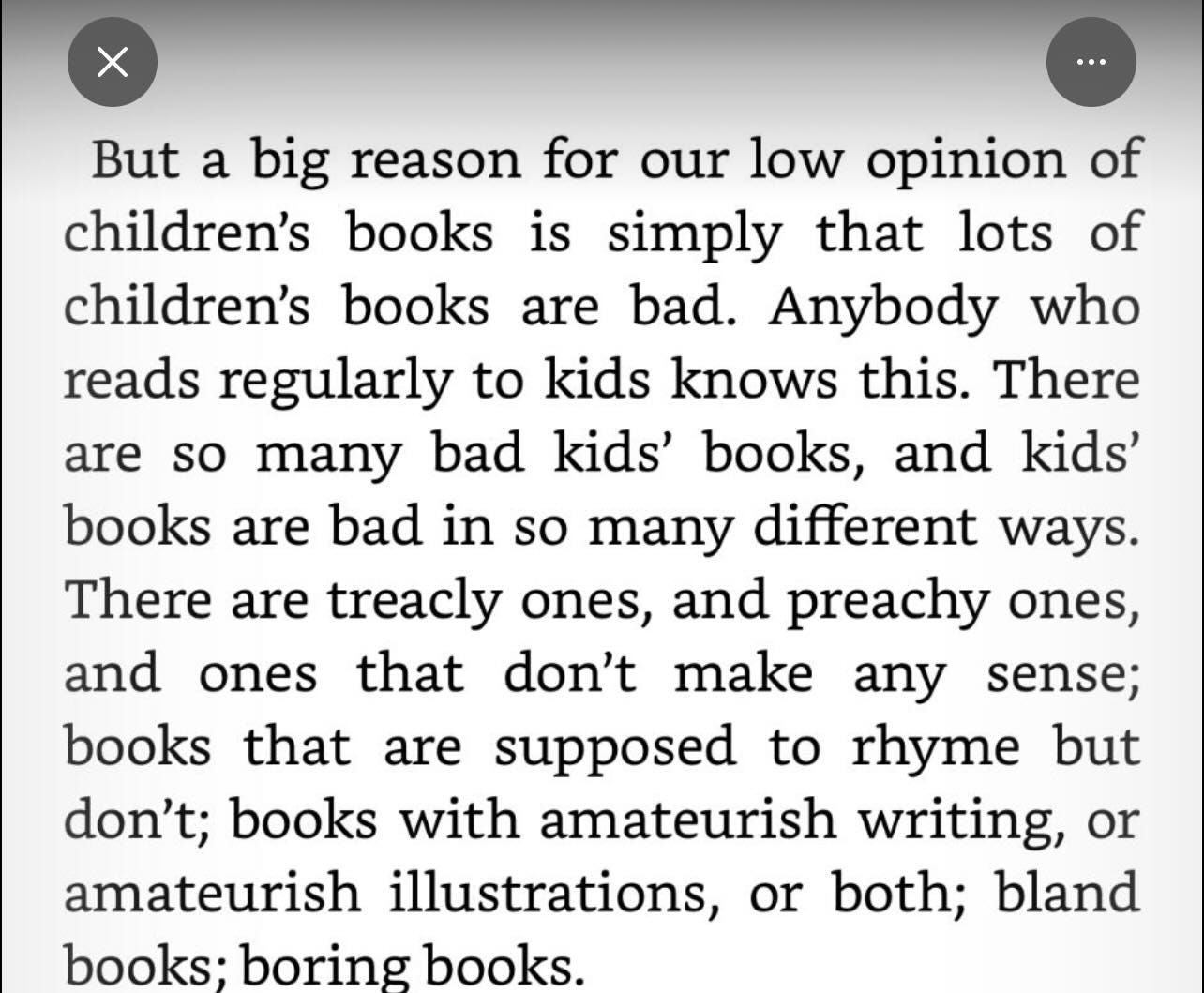
It’s hard to fathom why an author would do such a thing, but it comes down to privilege. His perception is that we’re all making a bunch of didactic crud out of a lack of imagination, but that is not the case. And just to be clear: there is no amount of context that excuses these mean-spirited words. He’s mean. This is mean, bullying behavior and it is not what we need from our Ambassador.
I read HUNDREDS of children’s books every year and the vast majority are well crafted and beautiful. Yes, there’s an up swell of AI slop now but Mac’s book was written and copy edited at least a year ago, before the AI boom. Yes, there are books that don’t circulate as well and we should pay attention to that while acknowledging the influence that gatekeepers have on which books circulate. Yes, there are bad children’s books, but not 94.7% of them.
Why can’t we lighten up and be more like Mac?
First of all, the word didactic means intending to teach. It’s not a bad word, though it has been used as a dog-whistle to oppress books that make some adult readers uncomfortable. Non-Western children’s stories are often very didactic, utilizing folklore and fables. But beyond that basic refutation of the idea that didactic = bad stories, which is nonsense unless the story is overly didactic, it is VERY hard to get a children’s book published, even really good ones.
Many of us pitch projects that are light and funny and get shot down. The acquisitions team relegates certain creators to certain types of stories or the editor pushes hard for a take-away message because they don’t trust readers to appreciate ambiguity. Some of the heavy-handedness comes from the mill of the publishing industry forming us into bite-sized chunks that fit neatly into marketing boxes. I try to inhabit a grayer space in my stories but it requires a special editor who is willing to trust you over what the sales & marketing team wants, so most authors—especially those without privilege—don’t get the opportunity to be more subtle and less on the nose or even a little messy and original.
Why does someone like Mac Barnett get to take risks and experiment while others are told it’s too risky? I think we know why. Traditional publishing favors straight white men. They get to do things others don’t get to do, often because the largely female buyers of books fawn on attractive, charismatic, straight white men so their books sell very well. Then their great sales lead to them getting even more freedom to experiment and play and make books without heavy influence from acquisitions, marketing, & sales. That’s a huge factor in what we see in the market. Mac gets to control what he publishes while the rest of us often do not. And I say that as a cis white woman with more privilege than many in my field.
The difference is that I’m aware of my privilege.
The facts about children’s literature
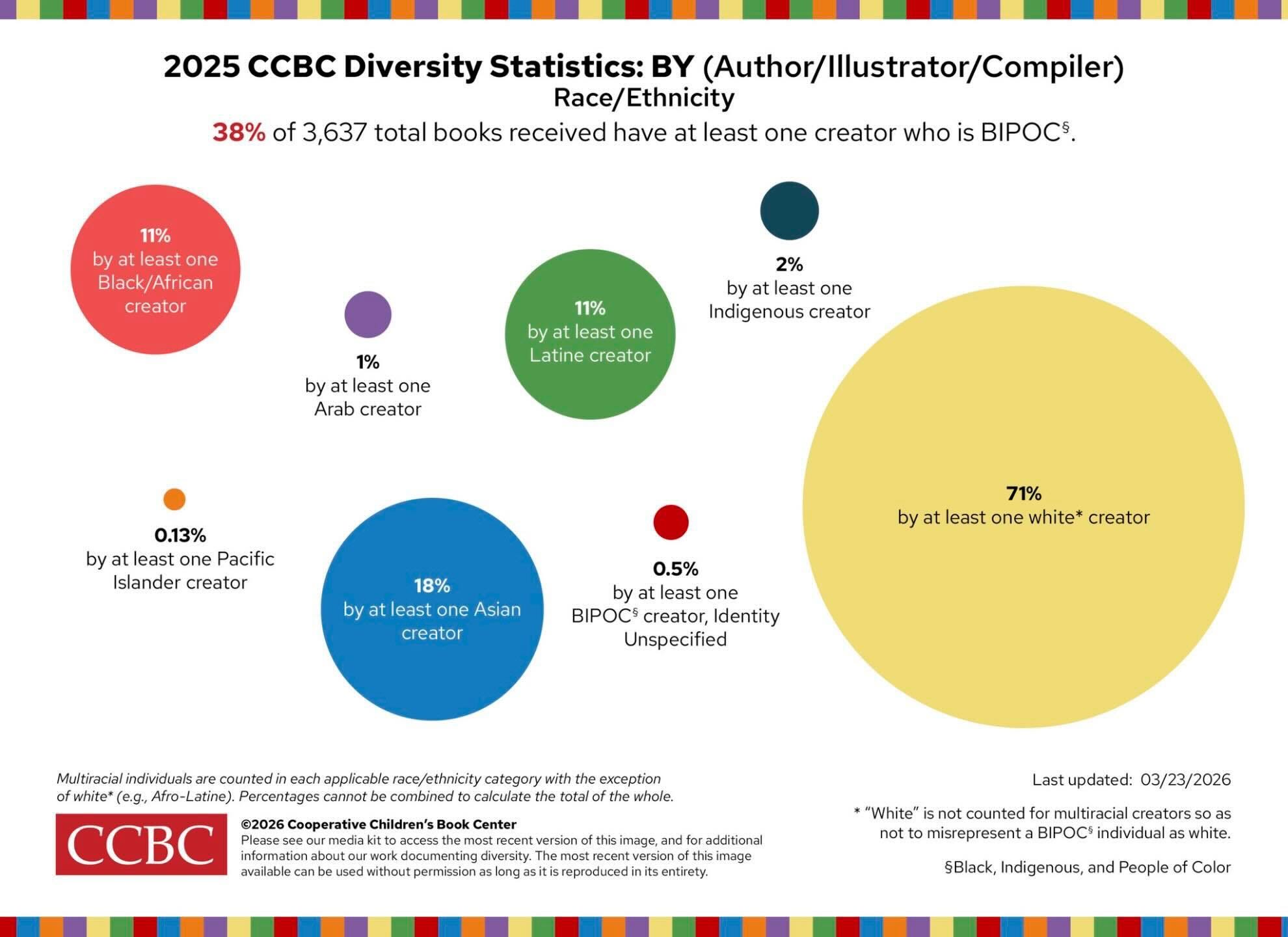
Of 3,637 children’s books surveyed by the CCBC, 71% were by white writers
The Diversity Baseline Study states that as of 2023, 72.5% of publishing professionals were white
76% of book reviewers were white
Book bans are rampant in the United States and it has devastated children’s literature. Marginalized creators were already fighting for space on the shelf as illustrated by these numbers from the CCBC, but with the added pressure of book bans, many have been unable to sell a new project in the last 12 months. I know this because I have marginalized friends, which I’m guessing Mac Barnett does not. If he did, he would never make such a callous statement denigrating 94.7% of our books because he would recognize how dangerous his statement is.
Any blanket dismissal of the quality of children’s literature gives fodder to the book banners. It empowers self-righteous gatekeepers who think “kids don’t need to read about THAT”—whatever THAT may be. Anyone with awareness of the current climate in children’s literature would realize that we are fighting for the right to read, but I guess Mac Barnett hasn’t volunteered much for Authors Against Book Bans. You’d think maybe an Ambassador to Young People’s Literature would be more in touch with the issues facing young people’s literature, but from the pages I have seen in his book, he is largely concerned with himself. Or, as Afoma Umesi puts it in her well-delivered piece on the matter, he’s a snob.
What do we do now?
Creators need to do their due diligence of talking with young readers, hearing what they’re into, and meeting their needs. We need to center our young readers in our work but we also need to recognize how the industry limits most of us until they see numbers that support our ideas. I’m working on a short, heavily illustrated middle grade fantasy now because the tremendous drop in middle grade consumption over the last few years convinced my publisher that we need it, but I couldn’t have gotten traction with a book in this format a few years ago.
We need systemic change in the publishing industry. We need space at the table for all voices. We need the powerful among us to lift up other voices. We need adult buyers of books to support a wide range of creators. And we need publishers to support the work we know the young people want to read.
So we keep trying. We keep subbing books that don’t get picked up, because without our crud, there will be no more readers. Children's authors create the next generation of readers. We are masters of our craft.
We will continue to do this work, together.
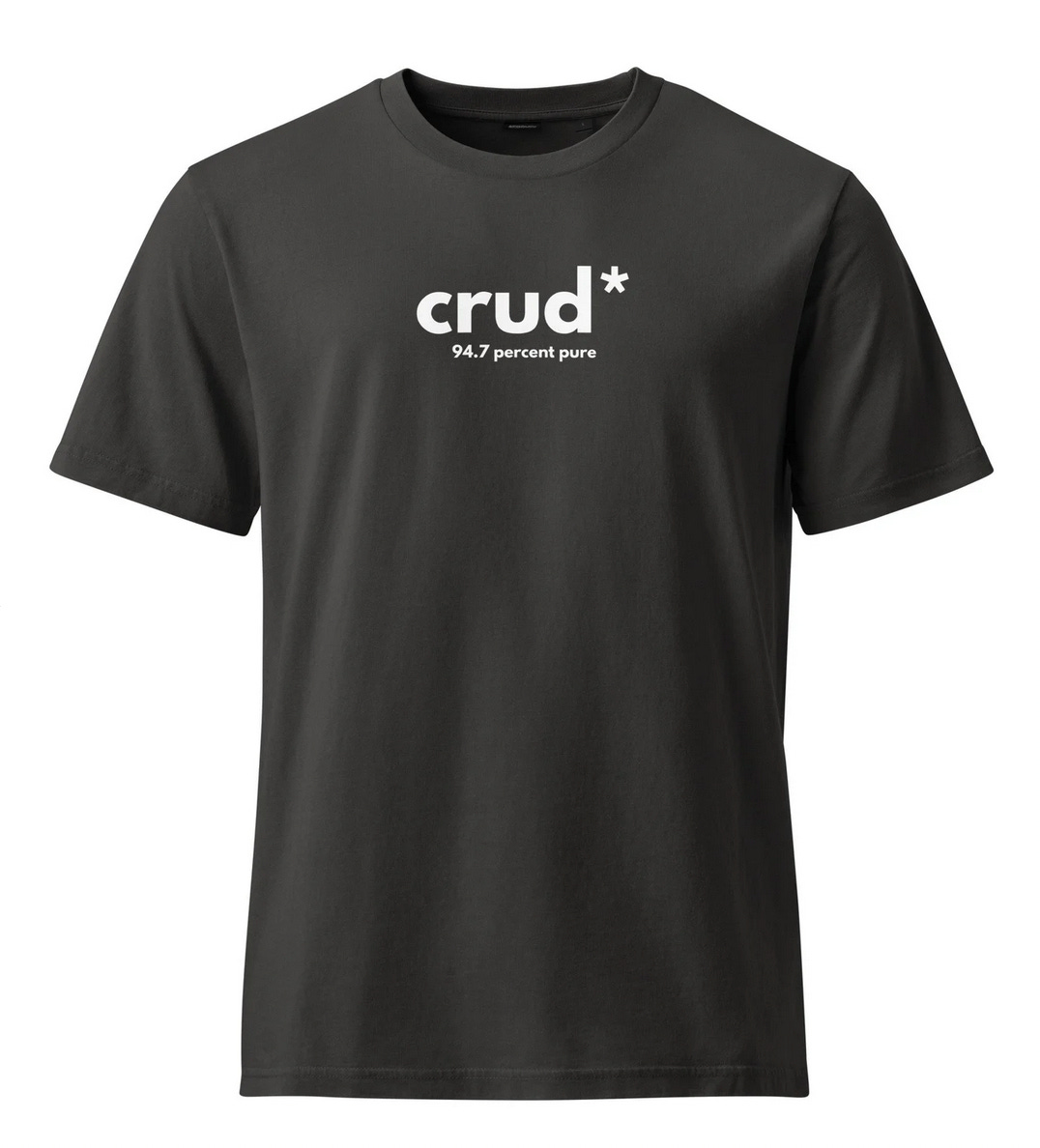
The amazing Martha Brockenbrough created this shirt. All proceeds benefit Authors Against Book Bans. Feel free to let me know what you think or feel in the comments. I’m here to listen and support. Writing is a team sport and I am here for you.

If you enjoy this post, please share it with friends! Or feel free to click the ❤️ button so more people can discover Mel’s Notebook on Substack. Thank you!!! 🙏
Thanks for this post. You are putting your finger on something most people are not aware of: it's the industry's gatekeepers, and not the authors, the ones who decide which children's books make it to the shelves. As for Mac Barnett's lazy and irresponsible affirmation, that's the perfect case of privilege mistaken for superiority, similar to those grandiose statements we unfortunately are constantly getting from people in power.
Thanks, Mel. You have synthesized the myriad of moving points in this post. This silencing of creators, or siloing them into writing only one type of story because that's what the INDUSTRY has decided is a huge part of the problem.
I again will bring up the issue of lack of certified school librarians across the US and how paraprofessionals are being installed to take our place. Some educators and most kids will call whoever is staffing the library a "librarian".
The curation of books for a specific school is a course taught at the graduate level. It is a semester long course in collection development. School demographics, the collection of books are already in the library, the age of books, the topics that need to be covered all enter into a certified librarian's assessment of what is added or weeded. This is an ongoing process that an aide can not handle. Add to it that, that library budgets have been slashed while book prices rise, and you have another piece of this systematic problem.