


Because this topic is so important to discuss, today’s paid newsletter is free for all to read.
There’s a lot of discourse these days about generative AI and whether or not we should use it. There are valid environmental concerns with the use of AI, which requires data centers that use a tremendous amount of water and electricity. There are also those who advocate for generative AI as a matter of accessibility, but disability advocates say AI discriminates against those with disabilities even when using ethically built AI platforms. Most of the current generative AI models were trained using stolen art—including my books—which makes them wildly unethical. For me, the fundamental argument against using generative AI is that you don’t need a machine to think for you. The human brain was made to create. All the machine does is mash up other people’s words and ideas and spit it back at you. That’s not art.
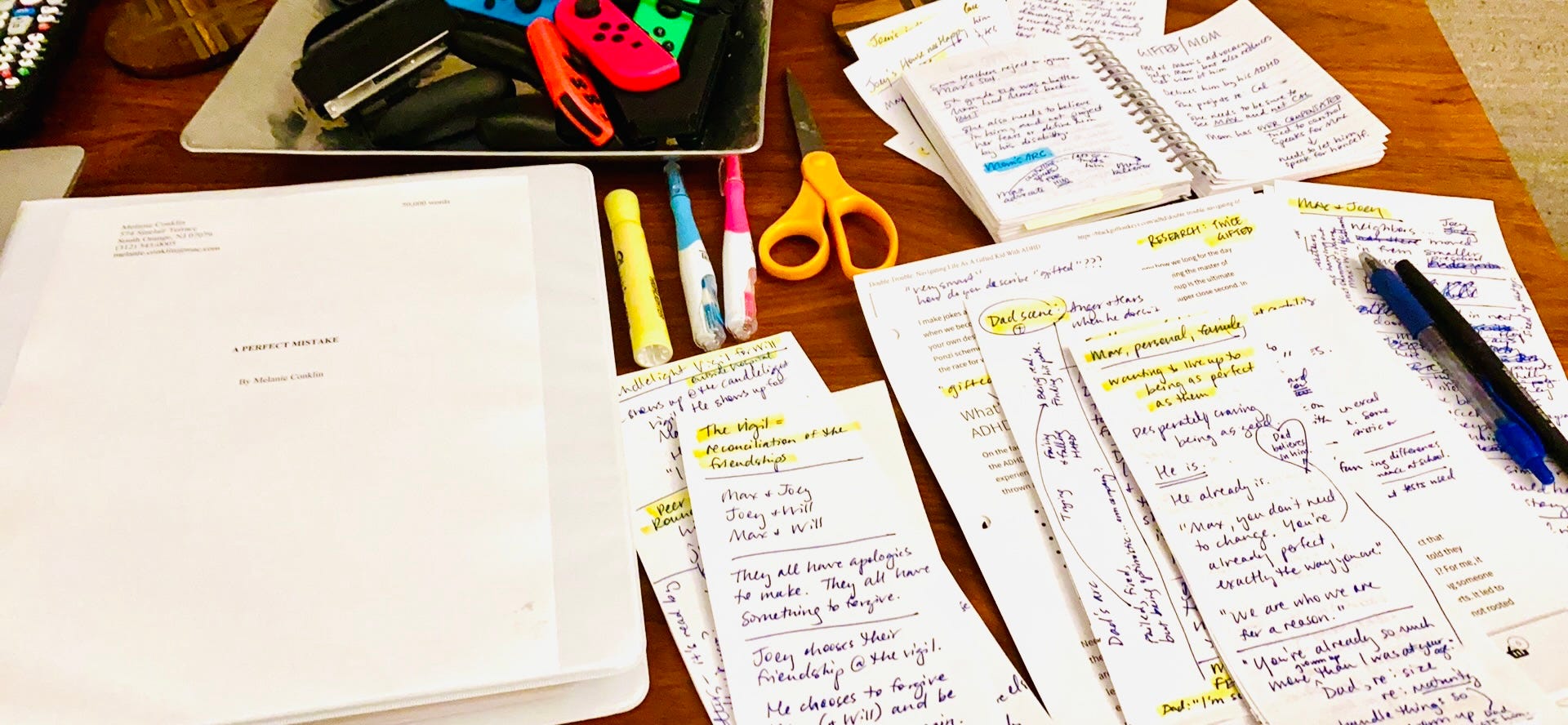
This installment of Mel’s Notebook is emailed to paid subscribers every Thursday at 9AM EST. If you would also like to receive it by email, become a paid subscriber and and get a peek behind the scenes of my creative life!
First, regarding accessibility and AI use, I am not a disability expert so I defer to organizations like The Disability Institute that have studied AI use and how it can support disabled users, making jobs and life more accessible for those who are often shut out of traditional workplaces. However, these advocates also say that because generative AI was trained on the output of a society that discriminates against disabled individuals, AI also perpetuates harmful stereotypes and should be used with caution.
Beyond the question of accessibility, generative AI comes with a laundry list of ethical concerns. As I mentioned at the outset, the majority of AI platforms were built using stolen art. Why? AI models have to be trained. AI companies use data to train their AI models, and most of them decided to use pirated book databases because it would have been cost prohibitive to pay for access to the copyrighted material. I’m sure you see the ethical irony there—they knew our books were too valuable to pay for them, so they stole them. My books included. There are dozens of lawsuits in progress on this matter, and so far the AI companies are losing, but not big enough in my opinion. At best, authors are being offered a payoff for having had their work stolen. None of the AI models are being shut down for this egregious violation of ethics. Instead, they use our books to spit out slop for anyone who’d like to pretend they “wrote” a novel.
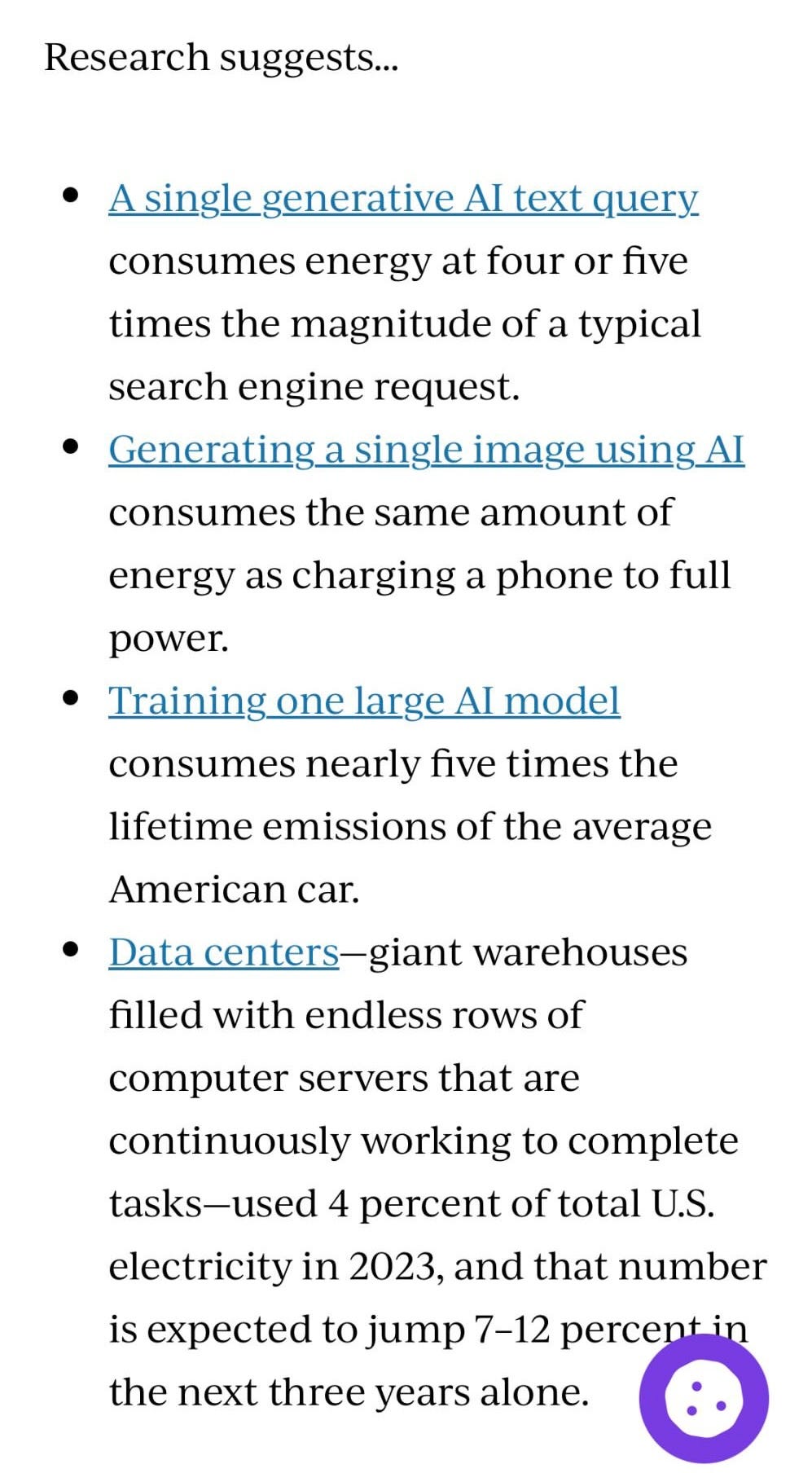
While there are some AI companies that claim to have trained their models on ethically sourced material, all AI still requires massive computing power to function. A single AI search requires four to five times the energy than a typical search engine request. Generating a single AI image consumes the same amount of power as charging a phone to full power. The data centers that power AI platforms guzzle water and electricity at unsustainable rates that scientists warn will usher in the coming global climate catastrophe at warp speed. And the really sick bit here is that WE DO NOT NEED TO USE AI. Our brains can and should do most of what we’re using AI for, and in fact, it’s critical that we do so for our own health and well being.
When you use generative AI to think for you, this is what happens to your brain: the connections weaken. According to a study at MIT, as the use of external tools rises, the cognition in the human brain diminishes. They conducted a writing study with three groups: brain only, brain plus search engine, and brain plus LLM (ChatGPT). “Brain-only participants exhibited the strongest, most distributed networks; Search Engine users showed moderate engagement; and LLM users displayed the weakest connectivity. Cognitive activity scaled down in relation to external tool use.”
“…LLM users displayed the weakest connectivity. Cognitive activity scaled down in relation to external tool use.”
The research participants who used LLMs for their writing assignment showed reduced alpha and beta connectivity, meaning their brains weren’t firing as much as the other participants. LLM users struggled to quote their own work. Over four months, LLM users consistently under-performed at neural, linguistic, and behavioral levels. Using generative AI to write literally made these people less capable of learning and thinking for themselves, and it was measurable. This raises tremendous concerns about the use of AI in educational settings. When you use AI to think for you, you do not learn the same way you do on your own. That’s a FACT. These AI companies aren’t trying to help you or make your life easier. They want us to use AI so we’ll become incapable of thinking for ourselves and dependent on the technology so they can capitalize on it to make more MONEY. That’s all they care about. There are already humans being harmed by dangerous AI chatbots that damage mental health, and yet these companies barrage us with products faster than they can be regulated.
Brandon Sanderson recently posted a video on AI and art, where he likened using AI to being the art director for a machine. Just as he gives art notes to an illustrator, an AI user gives prompts to a machine, but the art still belongs to the person creating the art—not the one directing it. So just as he doesn’t own the illustrator’s work, an AI user doesn’t own the AI’s work. This is a good argument for why the work made with AI isn’t really art, but an even better one is that art-making is a process, not a result.
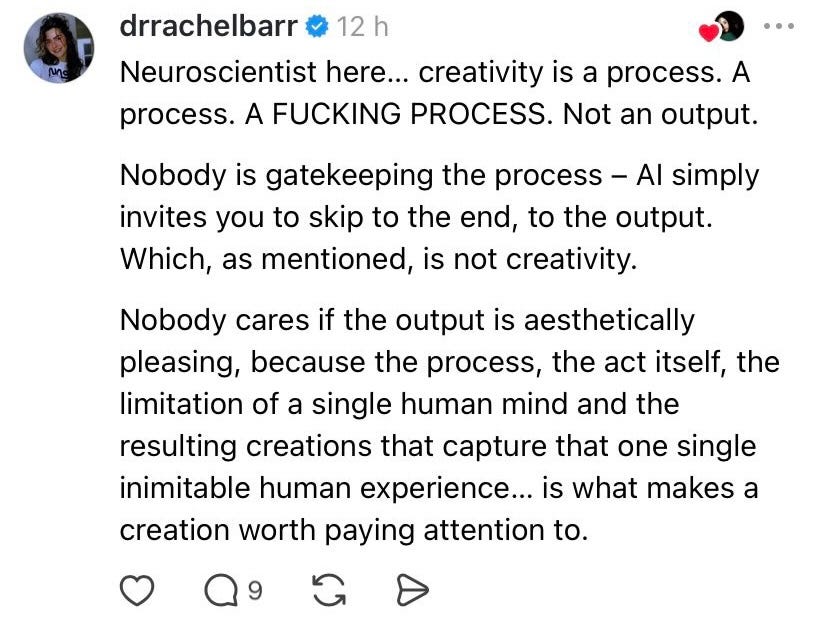
When we create, our brain literally forges new connections. With every breakthrough, we change at a biological level. That’s nothing short of magic. Making art is about leaning into the void and discovering what it shows you. That is a uniquely human skill and you are missing out if you use generative AI. Is it hard to make art? Is it sometimes exhausting and humiliating? Do you sometimes question your sanity or feel worthless? Yeah. You experience the full range of emotions when you use your brain to create something. And THAT is the value of creating. Creating changes you. You become something MORE. You evolve, you learn, you GROW AS A PERSON ✨
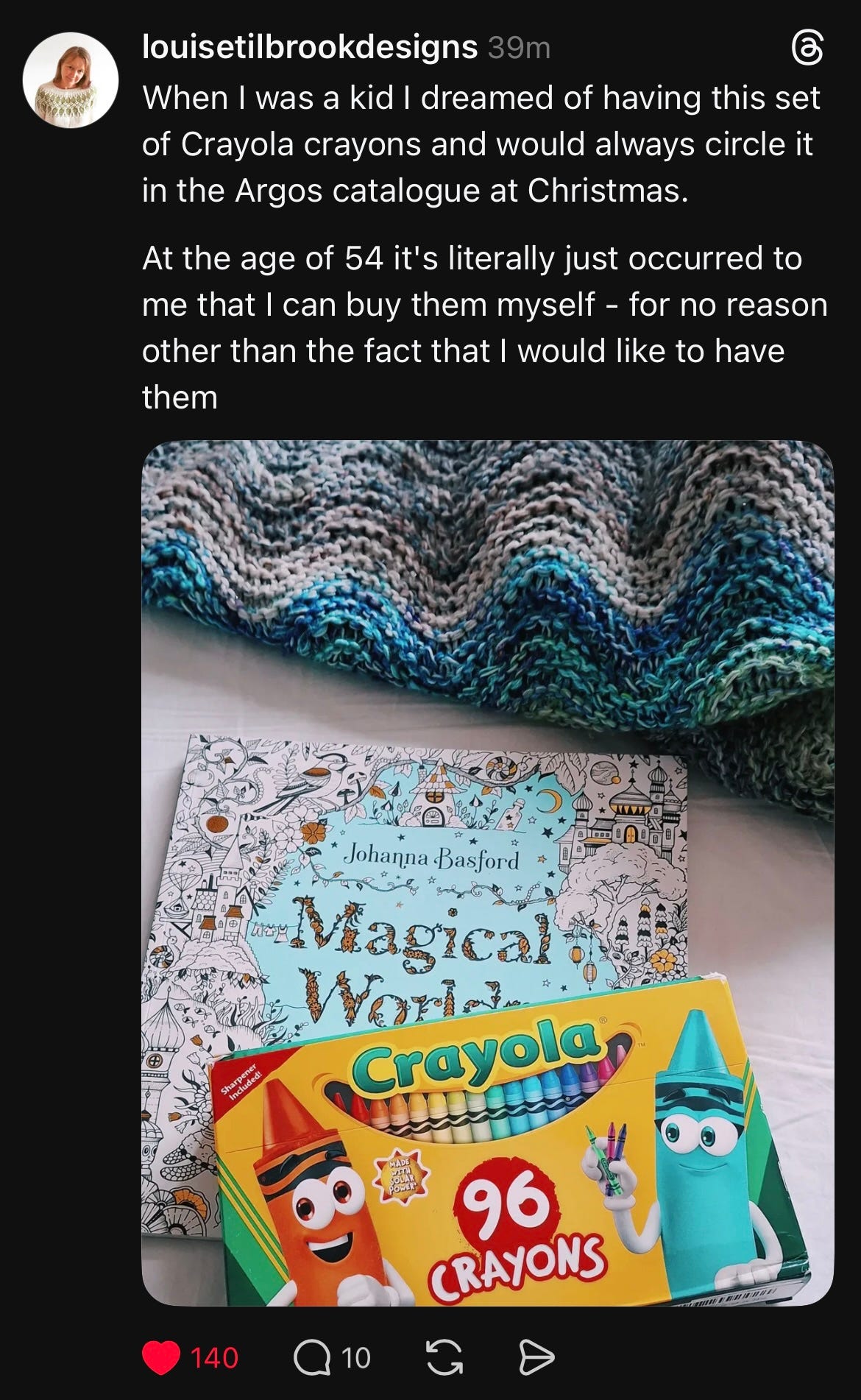
While it’s tempting to skip to the payoff and pop out a book with ChatGPT in minutes, the true value of art is the creative process itself. We as humans need crayons. We need messy piles of paper and ink pens and paint smears. We need the joy of making, not the empty satisfaction of telling a machine to make something for us. I have confidence that most people are already sick of AI slop and human creativity will be even more in demand in coming years. I ask everyone to please consider not only AI’s dubious ethics and environmental consequences but the very real damage it does to our brains. We don’t need AI. We were born to create.

If you enjoy this post, please share it with friends! Or feel free to click the ❤️ button so more people can discover Mel’s Notebook on Substack. Thank you!!! 🙏
You said in your post from TODAY, THANKSGIVING DAY, that I could call at any time, so here I am. I am Canadian, so our Thanksgiving was more than a month ago. But I am alone, as I mostly am, a little bit sad now and then, in some pain and ache, but nevertheless in peace and contentment and never far from my inner pool of gratitude. When I became a widow 2.5 years ago (at 85 then) I was alone for the first time ever. Big surprise, I love being alone. I totally relate to what you describe, this jubilant feeling that I can do what I want, when I want it and skip all duties if I choose to. Pajamas are great to live in, I am warm and cozy, and today I have had 2 naps already. I am an introvert like you, so this is really wonderful. Wishing you a wonderful, creative, lazy and uplifting Thanksgiving, filled with gratitude and peace. Maria
I agree, we are first and foremost CREATORS, and creation is a process. Moreover, my belief is that we ARE souls, we don't have souls. AI are soulless machines, nothing else, not yet anyway. When we interact with art made by souls, we meet ourselves, we meet others, we mirror each other, we expand and we grow. That is the beauty of the creative dance of Self-realization. The journey, not the destination is the point. In fact one could see the journey as an ongoing destination. Have you ever read a book that was so good, that grabbed your heart and soul so deeply, that when you came to the end, you started from page one again!? I have. If you have too, then you know what I mean. Maria